Choose a bench scraper when your main jobs are dividing dough and transferring ingredients on a flat work surface. Choose a flexible bowl scraper when you mostly need to gather dough or batter from a bowl’s curved interior. These are starting points, not exclusive uses: King Arthur describes both countertop tasks and bowl work for its flexible scraper. Bench knife details, bowl scraper details.
Start with the edge, not the product name
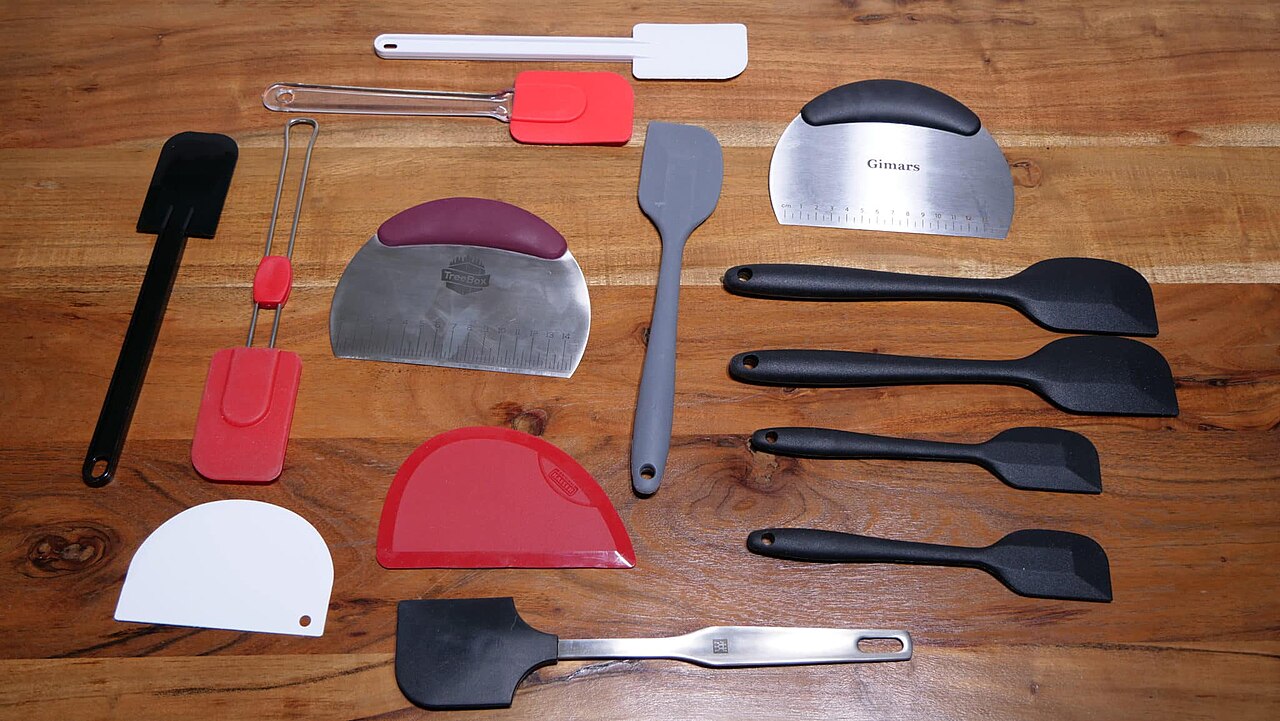
The familiar bench-scraper design has a broad, straight blade with a handle along its upper edge. King Arthur’s Bench Knife combines a stainless steel blade with a walnut handle and is intended for dividing dough and transferring ingredients. It also calls this tool a bench scraper or dough scraper—so those names alone do not identify different tools. King Arthur Bench Knife.
For bowl work, look for a rounded working edge and explicit information about flexibility. King Arthur describes its Bowl Scraper as flexible enough to follow bowl contours while retaining enough stiffness for work-surface scraping. That balance matters more than choosing a scraper simply because it looks curved. King Arthur Bowl Scraper.
My buying rule: identify where you want the edge to make contact. Prioritize a straight edge for a flat board and a conforming edge for a curved bowl. If a listing promises both, check how it explains the tool’s flexibility rather than assuming every edge performs equally well.
Match stiffness to the job
For frequent dough portioning, a handled metal bench scraper is a sensible first choice. OXO’s Multi-Purpose Scraper & Chopper is designed for portioning and scraping dough; its stainless steel blade also carries measurement markings. Those are useful features to compare if dividing dough is your main reason for buying. OXO Scraper & Chopper.
For batter-heavy baking, I would prioritize the bowl scraper instead. King Arthur specifically describes gathering and moving batter or dough and reaching bowl corners with its flexible edge. However, flexibility is not a standardized rating here: the description does not tell you exactly how it will fit your particular bowl. King Arthur Bowl Scraper.
There is also a middle ground. King Arthur’s discussion of its heavy-duty dough scraper describes rigid plastic with a sturdy straight edge for dividing dough, a broad face for transferring ingredients, and usefulness inside bowls. The practical inference is that plastic does not automatically mean soft, and a handleless scraper is not automatically limited to bowl work. King Arthur’s dough-scraper explanation.
Treat surface compatibility as a separate decision
Do not let a tool’s cutting ability answer the question of where you can use it. King Arthur warns that metal tools can scratch the nonstick coatings discussed in its scraper guide, contrasting them with its rigid-plastic dough scraper. Before planning to cut directly in a pan, check that pan’s utensil restrictions and the exact scraper’s intended uses. Material and surface discussion.
Likewise, do not extend a manufacturer’s claim about one plastic scraper to every plastic or silicone product. This guide does not establish universal coating compatibility or heat suitability for either material.
Compare the grip before extra features
OXO specifies a large, soft, nonslip handle and blade height intended to keep hands away from food. King Arthur’s metal alternative uses a walnut handle. These offer concrete construction differences to consider, but neither description establishes which will feel better in your hand. OXO handle details, King Arthur handle details.
Before ordering, use this checklist:
- Name your main task: dividing dough, transferring ingredients, or emptying bowls.
- Inspect the working edge, not just the overall silhouette.
- Request blade width and overall dimensions if the listing leaves them unclear; compare them with your workspace and drawer.
- For a bowl scraper, compare its outline with your smallest frequently used bowl.
- Confirm material, flexibility, surface permissions, and care requirements for the exact model.
- Treat ruler markings as an optional convenience rather than a reason to overlook an unsuitable grip.
Buy one first—or a complementary pair
My recommendation is to buy for the task your current tools handle least comfortably. Start with a bench scraper for repeated flat-surface work or a flexible scraper for emptying bowls. If you regularly need both, choose complementary shapes rather than two tools with nearly identical edges. You do not need a matching set to make a useful pair.