Choose a rolling pin by matching its shape to your usual baking, then checking its full dimensions against your counter and storage space. Start with a tapered pin for maneuverability, a straight dowel for broad, even rolling, or a handled model if you prefer a separate grip. These are useful starting points, not strict rules: King Arthur’s comparison emphasizes that comfort and technique matter more than finding one universally best design. King Arthur’s rolling-pin comparison
Start with the baking you actually do
For frequent pie baking, consider a tapered French pin. King Arthur’s comparison explains that the narrowing ends allow changes in pressure and make the pin easier to swivel when shaping a circle. The tradeoff is a learning curve: maintaining even thickness may take practice. French-pin handling comparison
The King Arthur French Rolling Pin is a lightweight, unfinished hardwood example. It suits a shortlist focused on direct contact with the pin rather than separate handles. However, “lightweight” does not mean short: the manufacturer describes it as long. Confirm its dimensions before assuming it will solve a cramped-drawer problem. French Rolling Pin details
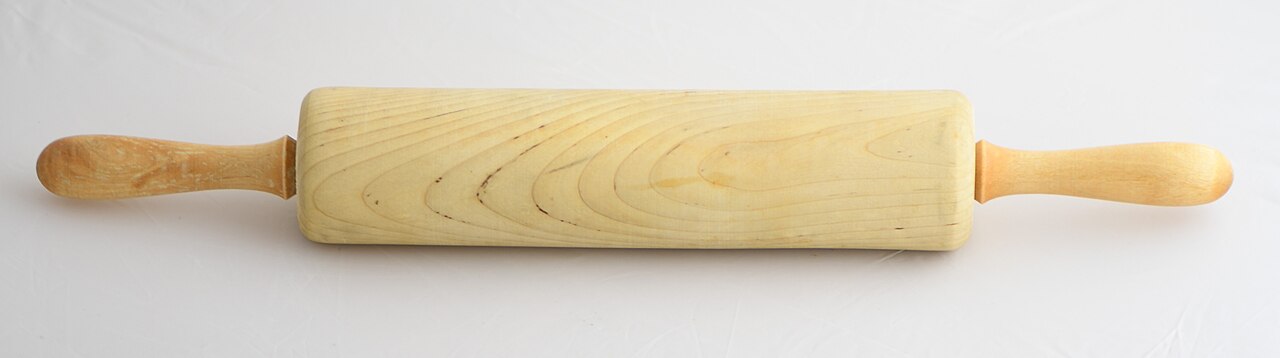
For a mix of cookies, pastry, and larger dough projects, consider a straight dowel. King Arthur describes its Straight Rolling Pin as having a broad rolling surface and a shape that helps distribute pressure evenly. Its lightly textured hardwood surface holds flour. That makes it a sensible general-purpose candidate, rather than a tool reserved for one kind of baking. Straight Rolling Pin details
Do not confuse versatility with compactness. King Arthur’s comparison describes its straight pin as relatively heavy and bulky. If you dislike lifting substantial tools, check the product weight rather than treating heft as an automatic advantage. Straight-pin comparison
Decide where you want your hands
If you prefer holding handles, look beyond their appearance. OXO’s Non-Stick Rolling Pin has contoured, offset handles designed to keep hands above the work surface. Its roller is coated steel. This is worth considering when hand clearance matters more to you than the simplicity of a wooden dowel. OXO design details
Before ordering, ask yourself whether you prefer gripping something or resting your palms directly on a pin. If you can examine a display model, compare those positions without assuming that a manufacturer’s comfort description guarantees your own comfort. Also consider everyone who will use it; a shared kitchen may call for a different compromise than a tool chosen for one baker.
Measure storage length and working space separately
Record two measurements for each candidate: overall end-to-end length and usable rolling length. Do not accept a listing’s single “size” measurement without checking what it describes.
For example, OXO lists overall dimensions of 2.8 by 3.5 by 20.9 inches. Use those specifications for a storage check, not as proof of the roller’s working width. Its descriptive text contains inconsistent size notation, so confirm usable roller length with the manufacturer if that measurement determines your purchase. OXO specifications
Try this practical fit check before ordering:
- Measure the drawer’s clear interior, including space lost to organizers.
- Mark the proposed overall length on paper and place it where you normally roll dough.
- Allow room for your hands and movement, rather than checking only whether the stationary pin fits.
- Check that you can lift it out of storage without first unloading neighboring utensils.
Treat surface and care as model-specific decisions
Wood and nonstick coatings offer different constructions, but neither label alone answers every buying question. King Arthur identifies its French pin as unfinished hardwood, while OXO specifies a nonstick coating on steel and labels that particular model dishwasher-safe. Do not extend those details to every wooden or metal pin. French pin construction and OXO construction and care designation
Before buying, check the exact model’s care instructions. If they are missing or unclear, ask for them rather than choosing a cleaning method based on material alone.
Your final ordering checklist
- Choose the handling style you want: tapered, straight, or handled.
- Confirm both overall length and usable rolling surface.
- Check weight if lifting or repositioning the tool is a concern.
- Match the exact model number to its specifications and care information.
- Decide where it will live before adding accessories or a second pin.
Start with one pin that fits your routine and your space. Add another only when you can name a specific task your first choice does not handle comfortably.